
English| EUR
Suggested for you
More currencies
Choose a language
Venice is a city you read with your feet: no cars, no ring road, just stone bridges and alleys barely wide enough for two abreast. A Venezia a piedi route through the sestieri needs no booking and no turnstile, though it does reward a sense of where the crowds break. This page sets out what an unguided walk actually gives you, and where a guided Venice landmarks route earns its place.
Quick answer
Walking Venice on your own costs 0 EUR: the city's streets, bridges and campi are public, and self-guided routes carry no entrance fee. They are also walkable at any hour, since the calli never close — the published pattern is 00:00–23:59, every day. The caveats are tide-driven acqua alta in autumn and museum or basilica interiors, which charge separately.
Venice is one of Europe's largest car-free urban centres: roughly 400 bridges link 118 islands, and not a single street carries traffic. That geography is why a Venice walking tour free of any admission charge works here better than almost anywhere else — the route itself is the attraction, and every calle, campo and fondamenta is public ground. Nothing gates the Rialto Bridge, the arcades of Piazza San Marco, or the long waterfront of the Zattere. The practical difficulty is not access but navigation. Addresses in Venice follow sestieri rather than streets, so a house number in Cannaregio means little without the name of a nearby parish. Wayfinding relies instead on nizioleti, the white painted signs that point toward San Marco, Rialto, Ferrovia and Accademia; follow them long enough and the city resolves into a handful of trunk routes with quiet capillaries either side. Self-guided walkers usually chain two or three sestieri — Dorsoduro into San Polo, or Castello out toward the Giardini — and let the Grand Canal act as the spine. A visita a piedi di Venezia organised this way covers more ground than a vaporetto hop, and reaches corners no boat passes. Guided walks run on a different logic. In the Veneto, commentary on monuments is restricted to licensed guides, which is why tip-based group walks tend to stick to open campi and street-level history, while ticketed small-group Venice walking tours handle interiors such as the Doge's Palace or the Basilica di San Marco. Reading the two formats side by side is the main decision most visitors face. Treat the open-air route as the base layer and add structure where it pays. A Venice walking tour free of any fee still rewards timing: autumn brings acqua alta, and the Centro Previsioni e Segnalazioni Maree publishes tide forecasts worth checking before an early start. Dedicated sections further down handle the weekly hours pattern, the quietest arrival window, costs and a worked route through the sestieri. For anything behind a door or turnstile, the booking pages carry live availability; the calli themselves ask nothing.
“In Venice the route is the attraction: every calle, campo and fondamenta is public ground.”
Exploring the public streets and squares of Venice on a self-guided walking tour requires no admission fee. Access to the city's outdoor layout is open to all visitors at no cost.
Verdict: A typical adult pays 0 EUR for walking tours, though private guided services or entry to specific monuments will involve additional costs.
The best arrival window is 07:00–10:00 to avoid peak cruise ship crowds and midday heat in narrow alleyways. Visiting during this early timeframe provides the most space to navigate the city streets.
Mild, 15°C–22°C. Pleasant for long walks before summer humidity sets in.
Cool, 10°C–18°C. Lower risk of intense heat, though acqua alta may occur.
—. Mid-week arrivals experience significantly fewer day-trippers compared to weekends.
Verdict: The best slot for a walking tour is Tuesday to Thursday, with an arrival between 07:00–10:00, during the months of April or October.
Venice operates as an open-air city, allowing visitors to explore public streets and thoroughfares at any time throughout the week.
This plan suits first-time visitors on foot who want to cross Venice from the station to San Marco without backtracking, covering roughly 4 to 5 hours at an unhurried pace. Distances are short, but bridges, steps and wrong turns add time, so treat the timings as a loose frame rather than a schedule.
Cross the Ponte degli Scalzi to Santa Croce and follow the yellow signs marked "per Rialto". The first 20 minutes along Rio Terà Lista di Spagna are the quietest they will be all day.
Walk south through the Santa Croce calli into Campo San Polo, one of the largest open squares in the city, then on to the brick facade of the Frari. Allow 30 minutes, more if you step inside.
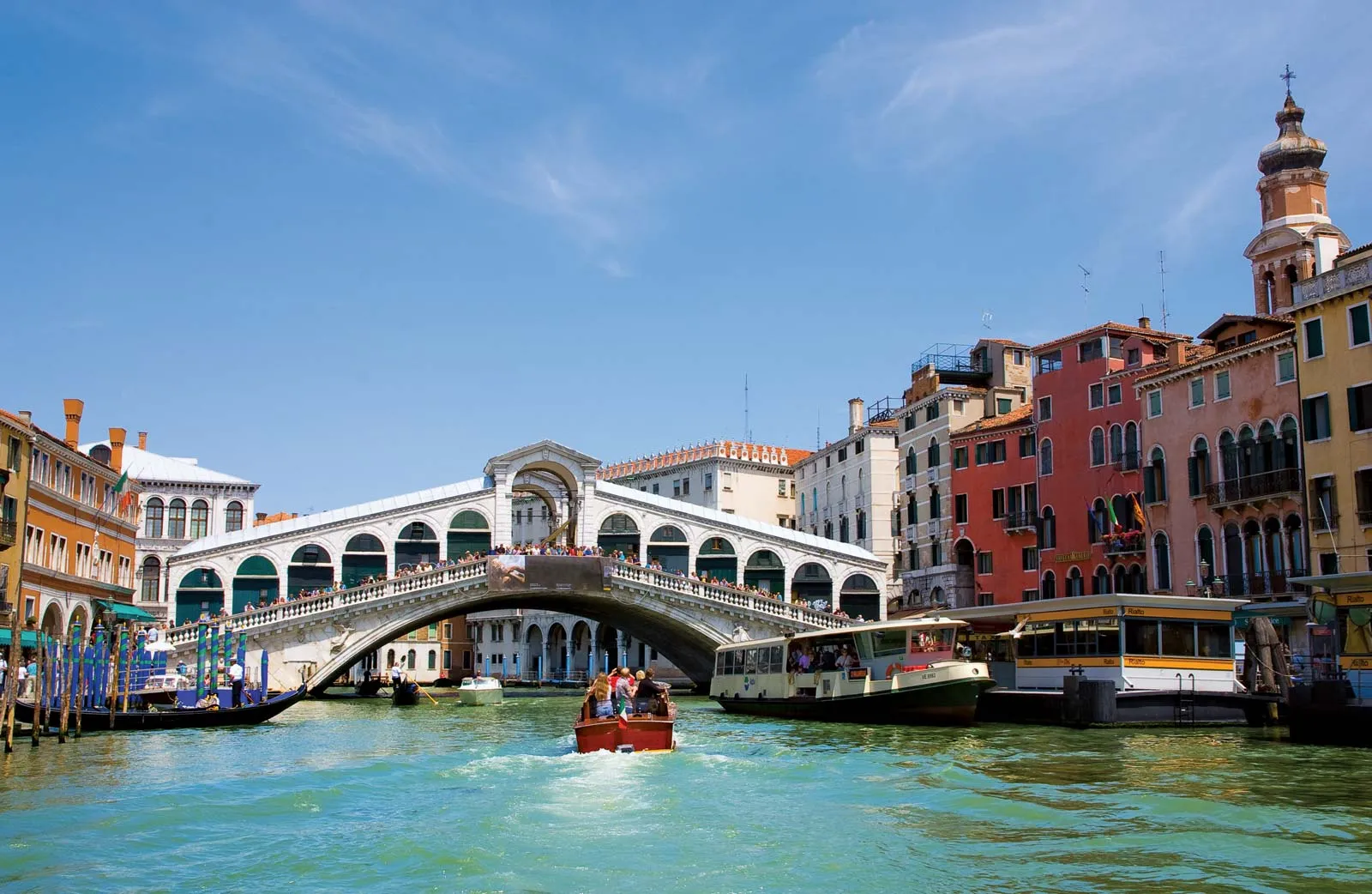
Reach the Pescaria fish stalls while traders are still working, then climb the Rialto bridge for the Grand Canal view. Expect 15 minutes of shuffling on the bridge steps.
Thread east through the shopping calli into Piazza San Marco. Walk the arcades, the Campanile base and the Piazzetta waterfront in about 40 minutes.
Follow the waterfront east past the Bridge of Sighs toward the Arsenale gates. Flat, wide and the easiest stretch for a breather.
Either continue into quiet Castello or take a vaporetto back west for the Zattere promenade and Accademia. Either adds 60 to 90 minutes.
Finish on the wooden Accademia bridge with the Salute dome ahead. From here the Grand Canal boats run in both directions.
Navigating Venice requires preparation to handle the city's unique geography and local customs effectively.
Wear broken-in, rubber-soled shoes to manage uneven stone paving and multiple bridge steps. Avoid heels or thin soles that provide little support on long walking routes.
Keep to the right when crossing bridges to allow pedestrian traffic to flow in both directions. Pausing in the middle of a bridge obstructs narrow paths and causes congestion.
Keep noise levels low in residential districts, especially during early morning or late evening hours. Refrain from sitting on bridge steps or private doorsteps, as these are active communal spaces.
Use offline maps or follow signage to specific districts rather than relying solely on GPS, which often loses signal in narrow, high-walled alleyways. Look for yellow signs on buildings pointing toward major landmarks like San Marco or Rialto.
Carry a reusable bottle and fill it at the public fountains found throughout the city. These fountains provide cold, drinkable water and help reduce plastic waste while you walk.
Everything you need to know about venice walking tour free
Yes, you can enjoy a venice walking tour free by exploring public streets and squares independently. Since Venice is a pedestrian-only city, the entire historic center is accessible at no cost.
Comfortable walking shoes are essential as you traverse stone bridges and narrow calli. Bringing a refillable water bottle is helpful, as Venice has numerous public fountains with fresh, drinkable water throughout the island.
While public areas are open, please note that a venice walking tour free does not include access to private palaces, interior museum galleries, or restricted religious sites. You must respect local residents by keeping noise levels low in residential neighborhoods.
To avoid heavy cruise ship congestion and the intense midday heat, plan your arrival between 07:00 and 10:00. This window allows you to experience the canals and campi while the city is quieter.
Yes, the flat terrain makes Venice suitable for walking, though strollers can be difficult to maneuver over the many steps of the city bridges. Planning your route to avoid busy vaporetti stops during rush hour will make the experience more manageable for everyone.
A professional tour offers historical context and stories about the Grand Canal or Saint Mark's Square that a self-guided experience may miss. If you prefer deep insights, consider booking an expert-led experience to complement your venice walking tour free.